Thursday, June 19, 2008

Reproduction: Identity and Biology


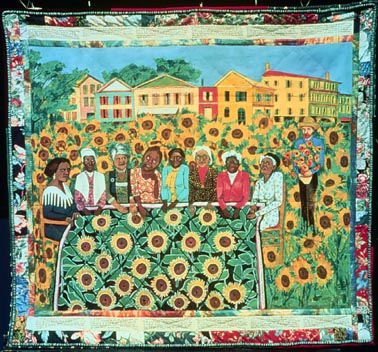
Gertrude Stein's famous line, "rose is a rose is a rose is a rose" makes clear that despite the all-male roster that dominates the art history discussed so far, reproduction has also been a central concern of women artists.[1] To name just a few from the past century: Janine Antoni's compulsive repetitions [PLATE 33], Judy Chicago's embroideries [PLATE 34], Kathy Grove's Other Series [PLATE 35], the Guerrilla Girls' advertisements [PLATE 36], Hannah Höch's photomontages [PLATE 37], Jenny Holzer's message loops [PLATE 38], Barbara Kruger's mass communications [PLATE 39], Sherry Levine's replications [PLATE 40], Bridget Riley's Op Art [PLATE 41], Faith Ringgold's quilts [PLATE 42], Miriam Schapiro's femmages [PLATE 43], Cindy Sherman's recreations [PLATE 44], Laurie Simmons' simulations [PLATE 45], Lorna Simpson's wigs [PLATE 46], and Kara Walker's silhouettes [PLATE 47]. The 1997 Guggenheim exhibition "Rrose is a Rrose is a Rrose: Gender Performance in Photography," pushes the connection between reproduction and identity even further, punning on Duchamp's feminine alter ego Rrose Sélavy (which sounds like "Eros, c'est la vie" or "Eros, that's life").[2]

When Walter Benjamin states that "even the most perfect reproduction of a work of art is lacking in one element: its presence in time and space, its unique existence at the place where it happens to be," he is describing reproduction as an outcome.[3] Reproduction, however, is not just a mechanical or digital result, but a profoundly biological process. Just as "[t]he uniqueness of a work of art is inseparable from its being imbedded in the fabric of tradition," according to Benjamin, so to are human identities formed only through the social and biological processes of reproduction.[4]

Reproduction becomes dizzyingly complex in the context of identity politics, with its demographic multi-dimensionality. But the lens of identity also simplifies one aspect of the discussion. Sexism, racism, and classism are at the heart of the historical prejudice that places reproduction at the bottom of the Western cultural hierarchy. Western aesthetic hierarchies have long relegated the traditional creative work of women to bottom rung, ranging from the medieval Bayeux Tapestry [PLATE 48] and other forms of textile design and manufacture to a wide variety of decorative arts.[5] Feminists and people of color from cultures throughout the world certainly do not share this view of the triviality of pattern and decoration.[6] Categorizing, stereotyping, marginalizing, and negating are not only the mechanisms for discriminating taste and differentiating between high and low; they are the basis for the reproduction of social structures, the classic way in which the powerful maintain their position of cultural dominance.[7]

Reproduction in its many forms, as well as its absence, has been central to shaping the history of identity politics. Reproduction spreads fame; omission silences pluralism. Reproduction means sex, birth, death, and evolution. Reproduction is rooted in the body and self image. Sexism and racism are all about reproduction and control, difference and illusion, lineage and heritage, integration and segregation, hierarchy and oppression. The myth of black lasciviousness is a typical racist stereotype to demean and restrain. The idea of "woman's work" centered on the home and reproductive duties is a typical sexist ploy. Both use reproduction as a hierarchical weapon of domination. Striking back are artists who are feminist, people of color, and queer (or LGBT: lesbian, gay, bisexual and transgender), exploring reproduction and their diverse relations to it as biology, technology, and sexuality in ways that disrupt dominant cultural understandings.[8]

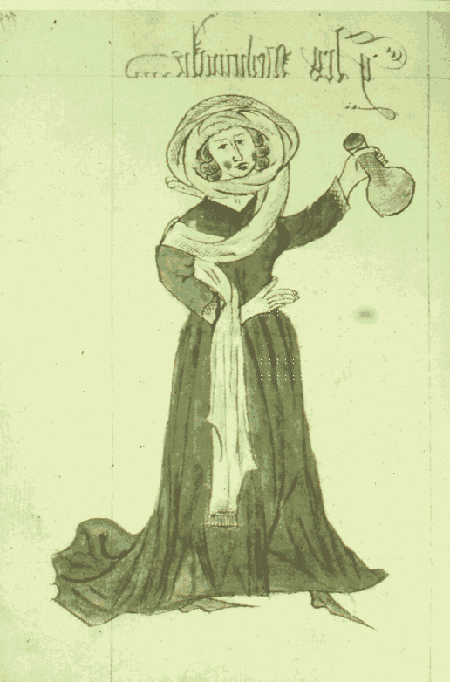
No wonder that the culture war's prime targets all happen to be artists who are people of color, queer, and/or feminist, including: Karen Finley [PLATE 49], Robert Mapplethorpe [PLATE 50], Chris Ofili [PLATE 51], Andres Serrano [PLATE 52], and an entire generation of hip hop artists whose experiments with sampling challenge the fundamentals of intellectual property law. There is an ancient tangled history of sexism, racism, and hierarchies of reproduction. Centuries before licensing first became law in England (focusing on mechanically reproduced print), the Catholic Church used ecclesiastical licenses to regulate the power of midwives vis-à-vis biological reproduction [PLATE 53]. These skilled women were so intimately involved with the sexual, moral, and mortal implications of reproduction that the Church felt compelled to use witchcraft as the ultimate means of accusatory control.[9] With the founding of universities in the Thirteenth Century, all-male medical faculties essentially outlawed female doctors. The Holy Roman Emperor Frederick II (1194-1250) enacted Europe's first medical licensure, requiring candidates to "swear to never consult with a Jew or with illiterate women."[10] From the Fourteenth to the Sixteenth Centuries, thousands of European women were burned at the stake for the "crime" of attempting to heal others.[11]

The historical linkages between racism, sexism, elitism, licensing, reproduction, and exclusion are as culturally deep as any factor influencing contemporary art today. The rub is that artwork which has remained furthest from public view for all manner of prejudice stands to benefit the most from the greatest reproduction and explanation. That is precisely what is needed to bridge the gap between message sent and message received, between hostility towards difference and openness towards familiarity. Remnants of tribal instincts compound the forces of separation. Artistic expression is a profoundly personal experience that strangely provokes intense psychological resistance to explanation and promotion. For most artists, it is far more difficult to write a simple, compelling artist statement than to produce their best masterpiece. No matter how technologically and culturally sophisticated our society becomes, we must struggle with base motivations. Is not that reality at least partly why a sacred image submerged in blood and urine provokes such strong reaction?[12]

We are living not only in an age of intellectual property and digital reproduction, but also an age of biology. Reproductive rights and copyrights are two of the most profoundly complex and intertwined areas of political contest in the world today, touching all aspects of our society and psyches, from the deepest held religious beliefs to the food we eat. Man-made things—seen onscreen or within urban settings—have replaced nature's prior visual dominance, enveloping our eyes within legal constraints. Artist, curator, and scholar Michael D. Harris points out that "images imposed from power are more difficult to subvert than language…. [I]mages are produced by the few to be consumed but seldom manipulated by the masses."[13] Our most advanced technologies of reproduction are disseminating images and advancing science to such an extent that they not only shape our individual identities but the very future of species, from genetically altered crops to the most advanced interventions of human embryology. Artists such as Brandon Ballengée [PLATE 54], Bureau of Inverse Technology co-founder Natalie Jeremijenko [PLATE 55], and Eduardo Kac [PLATE 56] explore the complex implications of these bio-tech developments.

Clone is just another word for reproduction, but what shivers it sends. Human aversion to technological reproduction is most biological, but there are complex cultural components to such attitudes as well. Internet pornography may be the ultimate technological reproduction of reproduction (process without product; product without process), and its meteoric market growth reveals an insatiable human appetite that is as biological as cultural. Artnet Magazine editor Walter Robinson calls "institutional critique" artist Andrea Fraser's "Untitled" video of having sex with her collector for $20,000 both "the most radical artistic gesture" of 2004 and "the most trivial" [PLATE 57].[14] In all of our roles as human beings—consumers, producers, thinkers, citizens, procreators, artists, etc.—each of us contributes to the evolution of these profound social, technological, and biological processes of reproduction.


1. Janine Antoni. Gnaw (detail). 1992.
600 lb. cube of chocolate gnawed by the artist, 24 x 24 x 24 inches. Collection of the Museum of Modern Art. Photo: Brian Forrest. Courtesy the Artist and Luhring Augustine, New York. http://www.pbs.org/art21/artists/antoni/art_sculpture.html


2. Judy Chicago. A Chicken in Every Pot. 1998.
Painting, needlepoint, appliqué and embroidery, 24 x 18". Collection of the artist and needleworkers. Courtesy of the Judy Chicago and Through the Flower. http://www.judychicago.com/judychicago.php?p=resolutions1


3. Kathy Grove. The Other Series: After Lange. 1989-1990.
Silver gelatin print, 71x 66 cm. This photograph digitally morphs Dorothea Lange's classic image "Migrant Mother, Nipopmo, California" (1936) into a smooth-faced model with dirt-free kids, air-brushing real-world problems into Madison-Avenue oblivion. Courtesy of Kathy Grove. http://academic.hws.edu/art/exhibitions/laughter/l2h.html


4. Guerrilla Girls. Women in America Earn Only 2/3 of What Men Earn. Women Artists Earn Only 1/3. 1985.
Poster. Copyright © 1985, 1995 by Guerrilla Girls, Inc. http://www.guerrillagirls.com/posters/twothirds2.shtml


5. Hannah Hoch. Made for a Party. 1936.
Photomontage. Institut Fur Auslandsbeziehungen Collection, Stuttgart. http://www.rmit.edu.au/departments/gallery/2002/Images/Image2.jpg


6. Jenny Holzer. Xenon Projection. 2000.
Fundación PROA, Buenos Aires. http://www.proa.org/exhibicion/holzer/salas/holzer-11.jpg


7. Barbara Kruger. Untitled (I shop therefore I am). 1987.
Photographic silkscreen on vinyl, 112 x 113 in. (284.5 x 287 cm). Private collection. http://www.ismennt.is/vefir/ari/myndlist/kruger_ishop.gif


8. Sherrie Levine. Fountain (after Marcel Duchamp: A.P.). 1991.
Bronze sculpture. Courtesy of Walker Art Center, Minneapolis, MN. http://www.askart.com/photos/cny11211996/277.jpg


9. Bridget Riley. Breathe. 1966.
Emulsion on Canvas, 117x82 in. http://www.mishabittleston.com/artists/bridget_riley/


10. Faith Ringgold. Flag Story Quilt. 1985.
Acrylic on canvas, dyed, painted and pieced fabric, 57 x 78". Spencer Museum of Art, Lawrence, Kansas. http://www.faithringgold.com/ringgold/d37.htm


11. Miriam Schapiro. Mother Russia (fan). 1994.
Acrylic and mixed media on canvas (femmage), 82 x 90 inches. Courtesy of Steinbaum Krauss Gallery. http://www.artlex.com/ArtLex/F.html


12. Cindy Sherman. Untitled #205. 1989.
Color photograph, 53 1/2 x 40 1/2 inches. Courtesy of the The Broad Art Foundation, Santa Monica, CA. http://www.broadartfoundation.org/collection/sherman.html


13. Laurie Simmons. Untitled. 2002.
Photograph, 5.5 x w: 8.5 in / h: 14 x w: 21.6 cm, edition: 25. Courtesy of Carolina Nitsch Contemporary Art, New York. http://www.artnet.com/artwork/138282/_Laurie_Simmons_Untitled.html


14. Lorna Simpson. Wigs (Portfolio). 1994.
Portfolio of 21 lithographs, sheet (each): 23 x 18" (58.5 x 45.8 cm) or 32 x 16" (81.3 x 40.7 cm). Publisher: Rhona Hoffman Gallery, Chicago. Edition: 15. According to MoMA: "Depicted here is a diverse group of wigs in an orderly presentation that suggests a lineup of scientific specimens. Simpson has used the traditional format of the print portfolio in which a sequence of images produces a cumulative, narrative effect." Courtesy of Museum of Modern Art. http://www.moma.org/collection/depts/prints_books/images/large/745_1995_1_38_simpson.jpg


15. Kara Walker. Jockey. 1995.
Cut paper mounted on canvas, 10 x 10 inches. Courtesy of Brent Sikkema, New York. http://www.nyss.org/cutout/walker.html


16. The Bayeux Tapestry. 1073-1083.
Embroidery in wool on canvas or linen, 70 m by 49.5 cm (231 ft by 19.5 in). One of the largest pieces of needlework ever undertaken, it depicts the Norman conquest and events leading up to it. Courtesy of Microsoft Encarta. http://au.encarta.msn.com/media_121618366_761553879_-1_1/Scene_from_the_Bayeux_Tapestry.html


17. Karen Finley. 1-900-ALL-KAREN. 1998.
Aldrich Museum of Contemporary Art (Ridgefield, CT), Allen Memorial Art Museum (Oberlin, OH), Arizona State University Art Museum. (Tempe, AZ), Contemporary Arts Forum (Santa Barbara, CA), CSPS (Cedar Rapids, IA), Diverseworks (Houston, TX), Center for the Arts at Yerba Buena Gardens (San Francisco, CA), MOCA (Los Angeles, CA), Museum of Contemporary Art, San Diego (San Diego, CA), Nexus Contemporary Art Center (Atlanta, GA), Out North Contemporary Art House (Anchorage, AK) and Wagon Train (Lincoln, NE).Commissioned and Organized by Creative Time, New York. http://asuartmuseum.asu.edu/finley/


18. Robert Mapplethorpe. Self Portrait. 1985.
Photograph. Copyright © The Robert Mapplethorpe Foundation. http://www.mapplethorpe.org/selfportraits7.html


19. Chris Ofili. The Holy Virgin Mary. 1996.
Painting. Courtesy of The Saatchi Gallery, London. http://www.guardian.co.uk/arts/gallery/image/0,8543,-11504640117,00.html


20. Andres Serrano. Piss Christ. 1989.
Photograph. http://www.usc.edu/schools/annenberg/asc/projects/comm544/library/images/502bg.jpg


21. Medieval Etching (not Trotula). nd.
"The belief that women were capable of doing physicians' work is represented in this mid-15th century image of Medicine as a Woman. This allegorical image depicts a woman holding up a flask of urine, often shown as the trademark of the physician in medical images during this period." Paula Findlen, Ubaldo Pierotti Professor of Italian History, Stanford University. "Images of the Female Body: The Middle Ages and the Renaissance," 2001. http://www.stanford.edu/class/history13/femalebody.html


22. Brandon Ballengée. Cleared and Stained Multi-limbed Pacific Tree frog. 2002.
Aptos, California. Ballengée's work provide disturbing images of deformities occurring in North American amphibians. The clearing and staining procedure involves a series of chemical treatments in which a specimen's tissue is "cleared" using a special enzyme. The cartilage and bone are then dyed red and blue resulting in a specimen that resembles a three dimensional x-ray. Digital imaging courtesy The Institute for Electronic Arts, School of Art and Design NYSCC at Alfred University, Alfred, New York. Courtesy of the Green Museum. http://greenmuseum.org/c/vban/index.php


23. Natalie Jeremijenko. OneTrees Project. November 1998 - March 1999.
According to the artist: "OneTrees is actually one thousand tree(s), clones, micro-propagated in culture. The clones were exhibited together as plantlets at Yerba Buena Center for the Arts, San Francisco. This was the only time they were seen together. In the spring of 2003 the clones will be planted in public sites throughout the San Francisco Bay Area." http://www.viewingspace.com/genetics_culture/pages_genetics_culture/gc_w09/jeremijenko%20lo%20res_300.jpg


24. Eduardo Kac. Alba (fluorescent bunny). 2000.
Photo: Chrystelle Fontaine. According to the artist: "My transgenic artwork "GFP Bunny" comprises the creation of a green fluorescent rabbit, the public dialogue generated by the project, and the social integration of the rabbit. GFP stands for green fluorescent protein. "GFP Bunny" was realized in 2000 and first presented publicly in Avignon, France." http://www.viewingspace.com/genetics_culture/images_genetics_culture/gc_wk_03/hoyt/albagreen.jpeg


25. Andrea Fraser. Untitled. 2003.
Still from video. Courtesy of Friedrich Petzel Gallery. http://artnet.com/Magazine/reviews/walrobinson/robinson12-30-10.asp


[1] Stein 1913.
[2] Blessing et al 1997.
[3] Benjamin 1935.
[4] Ibid.
[5] Gouma-Peterson and Matthews 1987, p. 332.
[6] Art Museum of Missoula 2004; hooks 1995, p. 196.
[7] Bourdieu 1984.
[8] Corber and Valocchi 2003; Axsom 2002.
[9] Brown 2003.
[10] Group and Roberts 2001, p 24.
[11] University of Iowa 2002.
[12] Hudgins 1987.
[13] Harris 2003.
[14] Robinson 2004.

Reproduction: Celebrity and Survival


Postmodernist critics such as Benjamin and Baudrillard lament the loss of originality, authenticity, and ultimately the primacy of reality as we have moved well beyond the print matrix to the film Matrix [PLATE 58], including the development of all of the mass-media technologies along the way: motion pictures, recording, radio, television, and most recently the computer.[1] Yet the inevitability of this "withering of aura" or "precession of simulacra" from advances in reproduction technologies seems greatly exaggerated. There are always unanticipated opportunities for resistance, critique, and change, no matter how intellectually compelling such philosophical arguments may be (even if they do inspire a major motion picture). Physical reality and the contradictions of daily life will continue to intrude upon our perceptions for at least the foreseeable future, despite the popularity of reality TV and video games. Especially in the tradition-bound marketplace for fine art, the tenacious value of originality retains its grip. The diversity of reality is incorrigible: a plethora of cultural choices remain even if finding alternatives has become difficult work.

That said, artist resistance to the evolution of mass media has generally proven futile. As actor Ben Gazzara recounts: "When I was in the theater, there was a snobbery about doing motion pictures. Motion pictures were beneath us. Then when I got into motion pictures, television was beneath us. And it's on and on and on. Now it doesn't matter any more."[2] Commercial success and the common self-interests of artists and their producers motivated these developments. The evolution of United Artists Corporation is a case in point. Four motion-picture celebrities (Charlie Chaplin, Mary Pickford, Douglas Fairbanks, and D.W. Griffith) co-founded UA in 1919 as a distribution company to challenge the power that major studios had over independent artists [PLATE 59]. By the 1950s, however, UA had grown into just another major Hollywood studio, and was gobbled up by Transamerica in 1967 then MGM in 1981, which in turn was purchased by a Sony-led consortium in 2005. Multinational media mega-mergers are daunting indeed, centralizing control of so much of what is seen and heard throughout the world, and further concentrating artist labor market disparities.[3]

The game of cultural reproduction produces clear winners, while generally hiding its losers. This evolutionary process provides a highly distorted view of the arts economy, even if a totally simulated hyper-real existence remains a philosophical and sci-fi fantasy. Arts and entertainment presents a classic winner-take-all economy.[4] Reproduction plays a central role in this game of survival. It broadcasts the success of winners, creating celebrities who model how artists live, what they do, and who they are. Such omnipresent imagery not only dramatically affects public perceptions of arts, entertainment, and artists, but even the perceptions of professional artists themselves who play the game from the inside. Media reproduced survival bias manipulates the psyches and ambitions of everyone who pursues an art career. The fact that such economics fail to provide a livelihood for nearly all working artists does nothing to stop the ever expanding enrollment in fine art departments, which already award 20,000 undergraduate and 3,000 graduate degrees in visual arts each year.[5] On the contrary, the charismatic myth of the "starving artist" inspires ever increasing levels of artistic production.[6] These motivations are so ingrained in Western Culture that only the King James Bible [PLATE 60] provides adequate description: "for many are called, but few are chosen," with deep implications for individual morality, work ethic, sacrifice, and spiritual reward.[7]

The market responds in specific ways to this surplus of artistic productivity. Celebrity culture combined with an appreciation model of aesthetic value focuses art-world transactions on the extremes of "neophilia" and necrophilia. Charles Saatchi is credited with coining the former to describe his habit of searching out new talent in art schools.[8] The recent dominance of conceptual art dovetails precisely with the phenomenon of the hot "emerging" artist and the explosion of the "new". The demand for novelty is usually met by artists early in their careers, often without subsequent significant innovation. This has led observers to claim contemporary art is flooded with masterpieces but few masters. [9] It has also fueled the fastest price rise at auction for works by contemporary artists compared with all other art in recent years, and focused collecting on speculation early in artist careers, since this increases the likelihood of catching the largest winnings.[10] A range of new financial derivatives and even a pension fund have been based on these odds.[11] The biggest payoff in such a model comes with an early demise of the artist, not only because the "death effect" limits supply, but even more so because the publicity surrounding such tragedy heightens the "nostalgia effect" and hence prices.[12] In the long run, the market pays more dearly for the work of dead artists than it rewards those still alive and "emerging". Which brings us back to reproduction: it is all about birth, death, and survival of the "fittest" in the canons of art history.


1. Larry Wachowski and Andy Wachowski. Matrix Revolutions. 2003.
Movie poster. Courtesy of Warner Brothers Entertainment Inc. http://whatisthematrix.warnerbros.com/rv_img/rv_poster_smiths.jpg


3. King James Bible. Genealogy 1. 1611.
R. Barker, London. The standard English version for 350 years, incorporating translations by Tyndale, Matthew, and Coverdale as well as other sources. This is a page from the "She" (corrected) issue in which Ruth 3:15 reads: "and she went into the city." Courtesy of The Regents of the University of Michigan, Papyrus Collection. http://www.lib.umich.edu/pap/exhibits/papyri_james/5_6_7.html


[1] Wachowski and Wachowski 1999.
[2] Gazzara 2004.
[3] Bagdikian 2000; Richardson and Figueroa 2004.
[4] Frank and Cook 1995.
[5] Derived from National Center for Education Statistics 2001, table 258.
[6] Røyseng, Mangset, and Borgen 2004.
[7] Matthew 22:14.
[8] Spiegler, February 2004.
[9] Galenson 2003, p. 20.
[10] Artprice.com 2004b, pp. VI-VII.
[11] Porter 2004; White 2004.
[12] Matheson and Baade 2003.

Reproduction: The Myth of Overexposure


If early celebrity is key to artist financial survival, and reproduction is key to celebrity, why would reproduction continue to have such negative connotations in the contemporary world of fine art? It partly boils down to conventional economics: the law of supply and demand dictates greater quantities yield lower prices, and, in the end lower quality and reputation, the ultimate art-world taboo.[1] There are also psychological layers of fear involved: loss of aura, originality, authenticity, and identity, selling out, and catering to consumer preferences. Many artists cannot abide the notion of their work as a reproducible commodity, equating "going commercial" with sin. French sociologist Pierre Bourdieu links this notion to a kind of magical pre-capitalist accumulation of symbolic capital.[2] Artists motivated by non-pecuniary benefits are more likely to pursue avant-garde work that is detached from market demand, causing a secular rupture between high and low culture.[3] The less reproducible is a work of art, the greater the incentive to find the highest bidder. The inverse of this tendency dominates the market for fine art. The entire industry is organized around capturing the most elite collectors, which requires an illusion of scarcity in the midst of overabundance. In this case, Baudrillard was right: myth creates reality, price creates demand. But bubbles can always burst if the right pin is applied.

The visual arts stand out as the most peculiar sector of the arts and entertainment industry when considering reproduction as key to celebrity and survival. There is an historical "path dependence" to the visual arts' exceptionalism, evoking the quirky tale of how the keyboard came by its inefficient QWERTY configuration in order to prevent typewriter keys from jamming [PLATE 61].[4] The cultural evolution of the visual arts industry in America is far more complex than that of the keyboard, and assessing impacts on artists requires more than a words-per-minute measure. Its most distinguishing characteristic relative to the other arts can be summed up in a word: "underexposure", that is, the lack of reproduction, publicity, and celebrity compared with other arts sectors and with visual arts in other countries.

There are many more visual artists working in the United States than any other kind of artist (including musicians, actors, directors, authors, dancers, etc.), yet the organizational infrastructure and market for visual arts is miniscule compared with the other arts.[5] The "art world establishment," as generally perceived, is dominated by museums, dealers, and auction houses, the largest of which are non-profit organizations (such as the Metropolitan Museum), privately-held corporations (such as Christies International Plc.), and family-run businesses (think of any Chelsea gallery). The visual arts in their entirety contribute just four percent of the revenues generated by the arts and entertainment industry.[6] Revenues from the three largest visual arts organizations (Sotheby's, the Metropolitan Museum, and MoMA) are less than one percent of the revenues from the three largest media corporations dominating film, publishing, and music (Time Warner, Viacom, and Disney).[7]

Most visual art depreciates in value, just like automobiles and almost every other commodity in the economy, but the entire fine art market is geared to the fraction of a percent expected to appreciate.[8] That means that most art produced by living artists has no transaction value whatsoever. For original works such as paintings, the higher the price the more likely it will appreciate in value over time, with works in the top 1.5% of auction prices, that is individual pieces worth well over $100,000, appreciating by the highest percentages [PLATE 62]. [9] Only a few dozen living American artists can claim such resale values. Yet there are nearly a half-million professional visual artists in America and more than five million Americans who display their art in public.[10] The promise of appreciation, and hence the benefit of the entire fine art market as it is currently constituted is a fantasy for all but a fraction of a percent of practicing visual artists.

There is a substantial literature on the poor labor conditions of artists: higher unemployment, lower earnings, lower returns per educational investment, fewer transferable skills, greatest earnings inequality, and highest rates of moonlighting.[11] Such conditions are starkest for visual artists, with its most extreme imbalance of labor supply and market demand. Average sales of art for 96 percent of the working visual artists total less than $600 per year. Add to that an average of $100 per artist in total direct grant funds from all federal, state, local, and private sources.[12] Only three percent of working artists, or roughly 20,000 people, succeeds in selling an average of $20,000 worth of work a year. Only 3,000 artists, roughly six-tenths of a percent of all working artists, are represented by New York City galleries. These privileged artists take in an average of approximately $75,000 per year from sales. Only 400 independent visual artists are successful enough to be able to hire more than one employee each. These celebrity artists make more than a half-million dollars per year in sales. The top independent U.S. artist alone commands at least four percent of all the money visual artists make in the United States. Art market sales are roughly four times more concentrated than what occurs in U.S. retail as a whole.[13]

Economic concentration is the hallmark of arts and entertainment, but stardom in the rest of the arts generates sufficient revenues to float massive corporations and hundreds of thousands of supporting cast and crew members.[14] This is accomplished by popular consumption of mass reproductions of artistic work.[15] In the visual arts market, in contrast, priority is given to exclusive ownership of original works by a handful of art stars. While favorable critical reviews boost attention in all of the arts, there is a complete disconnect in the primary measure of acclaim between the visual arts and the rest of the arts. For the latter, the number of units that sell defines success (books, CDs, DVDs, videos, tickets, etc.). All that matters in the visual arts, on the other hand, is who buys the work. The closest the visual arts gets to mass reproduction and publicity is advertisements for blockbuster museum shows (mostly for dead artists) and international art fairs (mostly for the aforementioned elite collectors), as well as the assortment of glossy fine art magazines.

ARTnews boasts being "the largest circulation of any fine-art magazine in the world" [PLATE 63]. Its 83,000+ subscribers have an average income of more than $200,000, have been collecting art for an average of 17 years, and have accumulated collections worth an average of $183,000. [16] Far from being anything remotely resembling a mass audience, this is precisely the ultra-elite universe of international collectors. Compare this to Rolling Stone, the largest circulation magazine in the music industry, with nearly 1.3 million subscribers—fifteen times the ARTnews readership [PLATE 64].[17] Total earnings of everyone who lives in nearly half of households with the mostly young-adult Rolling Stone readers are less than $50,000.[18] Is contemporary visual art inherently only of interest to rich people? Is contemporary music inherently an order of magnitude more popular? Or have these contemporaneous disciplines of art production merely evolved within different self-imposed cultural constraints, steeped in contrary attitudes about the value of various kinds of audience exposure and acclaim? Condé Nast's announcement in 2004 that it was planning to unveil an art magazine for the masses suggests that at least certain leading publishers and editors think the 60-million Americans who visit art exhibitions each year (more than attend professional sporting events) hint at a far larger greater potential market.[19] Unfortunately, the 2005 resignation of the project's spearhead, then editorial director James Truman, leaves the venture in limbo as of this writing.[20]

Living celebrities in all of the other arts are household names; not so for visual artists. Britney Spears may have to worry about overexposure as part of her brand management strategy, but such concerns for visual artists border on absurdity.[21] Obscurity is the real threat. Despite the unshakable myth of the working artist toiling alone, greatness is a rare posthumous discovery. The former is ubiquitous, the latter less likely than a lottery jackpot. New York Times culture writer Christopher Reardon points to William Congdon [PLATE 65], the last surviving member of the New York School, who died in monastic seclusion on the outskirts of Milan in 1998, as the classic "case study in how to derail a promising artistic career" by favoring solitary artistic integrity over fame.[22] The impact of underexposure also reaches to the very heights of accomplishment and prestige in the visual arts. Christies' 2001 sale of Bruce Nauman's 1967 wax and plaster sculpture Henry Moore Bound to Fail [PLATE 66] for nearly $10 million makes him the single most expensive living visual artist at the start of the Twenty-First Century. Yet how many Americans have even heard of or could recognize Nauman or his work? The visual arts' institutional focus on originality and its deep-seated antipathy towards the kinds of mass reproduction required for popular exposure are the very elements limiting its market reach and ultimately starving the majority of working artists.

One more symptom of underexposure: only visual artists have no organized labor representation. The rest of the arts have matured as industries and grown in scale to support a multitude powerful unions: Actors Equity, American Dance Guild, American Federation of Television and Radio Artists, American Guild of Musical Artists, American Guild of Variety Artists, American Musicians Federation, National Writers Union, Screen Actors Guild, Writers Guild of America, etc. The closest such organization for visual artists is the Graphic Artists Guild, which is geared towards design and illustration professional rather than the varied fine artists.[23] (Hence its membership base is omitted from the labor statistics presented above.) Ironically, the very origins of labor associations began with artisan guilds dating from Roman to Medieval times. With "gild" at their Anglo-Saxon etymological root, such organizations point directly back to Europe's first engravers and printmakers, who were commonly goldsmiths [PLATE 67]. At one extreme, to see the day-to-day value of such organizations for working artists, just compare the manifold protections of a standard "U5" acting contract for speaking under five lines on TV to the utter lack of legal safeguards from a standard consignment form for entrusting a gallery with tens of thousands of dollars worth of visual art inventory. On the other extreme, one need only look to the Fortieth President of the United States [PLATE 68] (or the current governor of California) to see what power such organizational development can truly muster. The political and economic power of reproduction has been all but lost on the visual arts with its overwhelming focus on individualism and originality.


1. Mad Editors. The QWERTY Mad. 1991.
New York, NY: Warner Books Inc. http://www.collectmad.com/collectibles/qwertymw.htm


2. Pablo Ruiz Picasso. Boy with a Pipe. 1905.
Oil on canvas, signed Picasso (lower left), 39 1/4 by 32 in / 99.7 by 81.3 cm. On May 5, 2004, the work was auctioned at Sotheby's - New York for $104,168,000, the highest price ever paid at that point for a single work of art. It was purchased by an anonymous buyer from the Greentree Foundation's Collection of Mr. and Mrs. John Hay Whitney. http://www.artchive.com/artchive/p/picasso/picasso_boy_with_pipe.jpg


3. ARTnews. Cover: Great Underrated Artists. 2005.
Volume 104, Number 1. January. http://artnews.com/images/covers/ACF1FBB.gif


4. Rolling Stone. Cover: 500 Greatest Songs of All Time. 2004.
Number 963, December 9. http://m1.buysub.com/wcsstore/RollingStone/images/R963coverct.jpg


5. William Congdon. La Madonna Del Presepio. 1984.
579x864 cm. SS. Pietro e Paolo alla Cascinazza, Milano http://www.christusrex.org/www2/art/congdon.htm


6. Bruce Nauman. Henry Moore Bound to Fail. 1967.
Plaster with wax, 26 x 24 x ca. 4 in. Sold for $9.9 million at Christie's New York, May 17, 2001. http://www.thecityreview.com/s01ccon1c.gif


7. Jan van Eyck. Portrait of Jan De Leeuw. 1436.
Oil on panel, 7.5" x 9.5" / (19.0cm x 24.0cm). De Leeuw was dean of the influential Goldsmith's Guild in Bruges. The origins of printing are intricately entwined with goldsmiths' tools and guilds. Albrecht Dürer would have first encountered the burin (or engraver) in his father's goldsmith shop; even Johann Gutenberg was affiliated with the goldsmith guild of Strassburg. Courtesy of Kunsthistorisches Museum, Vienna. http://www.artchive.com/artchive/v/van_eyck/eyck_leeuw.jpg


8. Ronald Reagan. Testifying before the House Un-American Activities Committee as President of the Screen Actors Guild. 1947.
October 25. Hand-tinted by Bennett Hall © 1999. Courtesy of Ronald Reagan Library and the Business Image Group, San Francisco, CA. http://businessimagegroup.com/presidentialimages.com/Reagan.html#Anchor-56321


[1] Heilbrun and Gray 2001, p. 176; Mutch nd.
[2] Bourdieu 1980.
[3] Cowen and Tabarrok 2000.
[4] Krugman 1995; Leibowitz and Margolis 1995.
[5] Bureau of Labor Statistics 2004; Nichols 2004.
[6] Goldman 2005.
[7] Combined 2001 revenues of $744 million for the top three visual arts organizations (Sotheby's $336M, Metropolitan Museum $240M, MoMA $168M) vs. $75 billion for the primary media segments of the top three media arts organizations (Time Warner $40B, Viacom $19B, Disney $16B). Albarran and Mierzejewska 2004; Philanthropic Research, Inc. 2004; Steiner 2002.

[8] Heilbrun and Gray 2001, p. 181.
[9] Artprice.com 2002.
[10] Bureau of Labor Statistics 2001; National Endowment for the Arts 2004; Nichols 2004; Goldman 2005.
[11] Alper and Wassall 2004.
[12] Galligan and Cherbo 2004.
[13] Goldman 2005.
[14] Rosen 1981.
[15] Adler 2005.
[16] ARTnews 2005.
[17] Adage.com 2005.
[18] At least according to RollingStone.com user profiles. RollingStone.com 2005.
[19] Carr 2004; National Endowment for the Arts 2004.
[20] Carr 2005.
[21] Frost 2004; Menkes 2004.
[22] Reardon 1999.
[23] Graphic Artists Guild 2003.

Reproduction: Still Second Class


Two years after Andy Warhol's death in 1987, Graham Nash [PLATE 69], of Crosby Stills Nash & Young fame, and David Coons, an Academy Award-winning animation engineer from the Walt Disney Company, produced the first digital IRIS fine art print.[1] Given the historical tensions and developments previously outlined, it is not surprising that the pioneers of digital art printmaking would be a rock star and a California-based film technician rather than a New York visual artist or master printmaker. Nash Editions has spawned a digital reproduction industry that could end the underexposure of visual art. The remarkable print quality that cost Nash $126,000 for an IRIS Graphics 3024 printer in 1989—an amount that only a celebrity could afford—can today be replaced by a wide-format Epson or HP inkjet printer for a few thousand dollars. Despite the potential, the art world is far from universally welcoming the full implications of this new technology, and instead displays the contradictory tendencies of elite resistance and avant-garde experimentation that have long been the twin trademarks of Western art history.

More than a decade after the first IRIS prints, digital printing and reproductions remain near the periphery of the fine art world, infrequently seen at Chelsea galleries, London auctions or even fine art print fairs. Great importance is still given to limiting the edition of digital prints, even though there is no technical reason for doing so, nor even the physical possibility (any digitally printed output can be rescanned and reproduced at virtually the same quality and size). Fourteen states have fine art print disclosure laws specifying detailed contents of certifications of authenticity, even though many parameters are nonsensical in the context of digital reproduction (such as status of plate or master).[2]

Consensus on nomenclature for digital applications remains elusive even in the most traditional media such as works on paper. Many try to distinguish between (a) "digital prints" of art created originally on a computer, (b) "digital reproductions" of art created with a different media then digitally photographed or scanned, and (c) a "fine art print" that directly involves the hand of an artist and master printmaker in some aspect of the process of reproduction. The problem with such distinctions is that all manner of combinations of these processes are possible, and all kinds of quality can result from any one, in terms of both artistry and materials. Jack Duganne, Nash Editions' first printmaker, coined the term "giclée" in 1991 based on the French verb "to spray" (gicler). Many American artists refrain from using the moniker, because of its simultaneously pretentious whiff of European origins and kitschy connotation of highfalutin sales-slick gimmickry hiding what may otherwise be an ordinary poster. Here we begin to stumble into the contraband terrain of inauthentic work, along with fakes and forgeries, among the most disreputable neighbors of reproduction.[3]

The unrivalled master of giclée is universally reviled by art-world aficionados, who call his work "schlock" and "a big turnoff."[4] As the top grossing artist in the world today—and by far—Thomas Kinkade, the self-described "Painter of Light™," can laugh all the way to the bank [PLATE 70]. He has reportedly sold more than ten million copies of his paintings (not one original!), earning more than $100 million per year for his corporation over multiple years (before taking it private in 2004), and generating more than $500 million per year in licensed product revenues.[5] His empire includes not only a finely articulated product schedule of signed limited edition prints that mimic art historical hierarchies (including various proofs, certifications, hand highlights, etc.), but all manner of goods from calendars to candles, greeting cards, furniture, wall paper, a novel (Cape Light), and even a real estate development ("The Village at Hiddenbrooke"), not to mention thousands of gallery franchises throughout the country, a 300,000-square-foot manufacturing facility in California, and hundreds of employees, including several executives who earn six- and seven-figure salaries and bonuses.

Many may doubt that Kinkade will ever be considered the Rembrandt of our times, or even looked back upon as a contemporary Norman Rockwell. Kinkade is the single most disliked artist by American art critics, according to a recent Columbia University survey.[6] (The critics give similarly poor ranks to LeRoy Neiman, another bestselling artist of reproductions.) Even an acclaimed champion of popular art such as Dave Hickey, who is famous for reviving previously discounted concepts such as beauty and artists such as Rockwell, says of Kinkade, "one of my 'heroes'[,] he isn't."[7] In addition to his 2001 MacArthur "genius" award, Hickey ranks as the fifth most influential writer among U.S. art critics in the same poll, above Walter Benjamin, Meyer Schapiro and Harold Rosenberg.[8]

There is no argument, however, regarding this indisputable historical fact: licensed sales of Kinkade's work are substantially greater than the revenues of any other organization in the visual art world today, including Sotheby's (the largest publicly held auction house), and double the revenues of the Metropolitan Museum of Art, the largest museum in the United States (including all of its sources of revenue: gift shop sales of reproductions and other paraphernalia, admissions, donations, art sales, etc.). It is even more incredible that broadly scanning the vast literature of contemporary American art—from academic books to glossy magazines to art websites—you might never even know he exists.

In return for his art-world anonymity, Kinkade, who graduated from the well-regarded Art Center College of Design in Pasadena, not only ignores the intellectual interests of the art-world elite, he unapologetically embraces exactly the kind of work held out for ridicule by the likes of Soviet émigré artists Komar and Melamid and their "America's Most Wanted" polls [PLATE 71].[9] So much scorn has been heaped on Kinkade and others who have pursued this populist approach to reproduction, that their enormous enterprise is all but invisible to participants and onlookers of the international art world. Wildlife artist Terry Redlin—who despite selling more than $20 million worth of Americana each year, single-handedly raising $28 million for Ducks Unlimited [PLATE 72], and building a $10 million museum for the State of South Dakota, still does not rank among the top ten art licensors—calls these contemporary masters of reproduction "a hidden industry."[10]

What historian Lawrence W. Levine terms the "cultural bifurcation" of America between high and low arts is most extreme in contemporary visual arts.[11] This is not just a matter of the general public's difficulties understanding and accepting the most challenging avant-garde work, which happens in all fields of artistic endeavor. More significantly, the connoisseurship that rules the visual art establishment disregards the largest segment of its own industry, discounting not only the aesthetics of such popular work, but its technological and fiscal underpinnings. The former is a matter of taste, the latter, financial suicide. In a single-minded pursuit of value through the monetary appreciation of celebrity output, the arbiters of contemporary fine art have ignored the very mechanism by which superstars are created: large-scale systems of reproduction. By snubbing individuals who have most successfully pursued the latter strategy, the art world has conspired with the art market to conflate reproduction with poor quality. Upon reflection, however, does not this equation seems so passé, rooted in early Twentieth-Century American anti-immigrant sensibilities (distinguishing between highbrow and low), and even back to the anti-photography sensibilities of the Aquafortistes?[12]


1. Graham Nash. Self-Portrait at the Plaza Hotel, New York. 1974.
Courtesy of Nash Editions, Manhattan Beach, CA. http://www.digitaljournalist.org/issue0105/nash01.htm


2. Thomas Kinkade. In the Garden of Hope. 2005.
Giclée, sizes: 16x12 / 24x18 / 34x25.5 inches. Artist's statement: "Hope is the great gift of a loving God. For people of faith, hope is symbolized in the dawning of each day, the assurance that God's love is new every morning. Hope lights our spirit in the midst of despair; it is the life force that 'through the green stem drives the flower;' it keeps a divine vision alive in the hearts of the weak and needy." Courtesy of The Thomas Kindade Company, Morgan Hill, CA. http://www.thomaskinkade.com/magi/servlet/com.asucon.ebiz.catalog.web.tk.CatalogServlet?catalogAction=Product&productId=203201


3. Vitaly Komar and Alex Melamid. United States: Most Wanted Painting. 1995.
Oil on canvas, dishwasher size. With the support of the Nation Institute, the artists hired Marttila & Kiley, Inc. to survey 1001 adults for America's most and least wanted paintings, which were exhibited as the "People's Choice" in New York at the Alternative Museum. With the sponsorship of the Dia Center and Chase Manhattan Bank, they expanded their market research to other countries, and created most and least wanted paintings for each. Courtesy of the Dia Center, New York. http://www.diacenter.org/km/usa/most.html


4. Hayden Lambson. Clear Landing (Ducks Unlimited Catalogue Cover). 2004.
From print, limited edition of 5,500; frame size: 22"H x 30"W. "Chosen to adorn the cover of the Ducks Unlimited catalog, 'Clear Landing'… [is] now exclusively available as framed and matted prints. This is the perfect chance to begin a distinct one-of-a-kind collection. A winter landscape, morning’s soft light, mallards cupped and ready to sit - Hayden Lambson’s artistic vision is that of a dedicated waterfowler and it’s strikingly apparent in this work. With 'Clear Landing' hanging in your home or office, you’re only a glance away from momentary freedom." Courtesy of Ducks Unlimited, Kearney, NE. http://www.ducatalog.com/catalog/default.php


[1] Johnson 2005.
[2] Art Publishers Association, nd.
[3] Elkins 2004.
[4] Davis 2004; Lazarus 2002; Miller 2002.
[5] Brown 2002; License! 2004; Media Arts Group 1997-2003.
[6] Szántó et al. 2002, pp. 40 and 44.
[7] Hickey 1993, 1997, and 2000; Dewan 1999.
[8] Szántó et al. 2002, p. 36.
[9] Wypijewski 1997.
[10] Cray 1999.
[11] Levine 1988.
[12] Gans 1999; Kammen 2000; Keller 2004.

Reproduction: The Secret is Out


Key financial fundamentals of the U.S. art market are remarkably little known. Intellectual property is the future of the American economy: imagination made real, creations of the mind, design and invention. This form of property, protected by patents, trademarks and copyrights, is one of our largest and fastest growing economic assets, contributing more than a trillion dollars to the domestic economy, and leading U.S. exports.[1] Arts and entertainment are at the core of this financial powerhouse, generating a third of all domestic and foreign intellectual property sales.[2] Visual art is the fastest growing sector of the international licensing industry, the key legal mechanism for marketing copyrighted materials.[3] Reproduction dominates art sales, yielding two-thirds of the $30-billion domestic art market, and increasing shares relative to original art and all home furnishings.[4] Framed reproductions are the largest and fastest-growing sector of the visual art market, with $16 billion in domestic sales, rising by 15% per year—double the growth of total art sales, and three times the sales growth for original art.[5] Digital fine art printing is expanding the fastest, with the market for reproductions using the latest technology projected to double within three years at a 20% annual sales growth rate.[6] Digital prints are expected to replace lithography and serigraphy as the primary fine art technology in 2005.[7]

Such compelling bottom-line data are rarely encountered in literatures relating to the visual arts. The information is from remarkably disparate sources, ranging from arcane government tabulations to industry associations for printers and printing equipment, publishers, home furnishings, international licensing, and intellectual property concerns. The fact that these resources are far removed from traditional origins of art world authority—be they art history or conservation, appraisal or criticism, art curating or art making—does little to diminish the compelling economic indications imbedded therein: the future of art lies in reproduction.

Comparisons with more familiar sources are no less revealing. According to Americans for the Arts, the combined budgets of all non-profit arts organizations in the United States total more than $50 billion per year.[8] The National Endowment for the Arts estimates that half of this amount is raised by donations (40% private; 10% public) and half by earned income.[9] Roughly 10% of this total is generated by the non-profit visual arts, including museums, alternative spaces, etc., and the rest by non-profit organizations in all of the other art disciplines (theaters, orchestras, opera companies, art service organizations, etc.).[10] In comparison, the Art Publishers Association puts U.S. sales of wall art reproductions at $20 billion per year.[11] Taken together, these estimates suggest that art reproductions generate as much revenue as all foundation, corporate, and individual donations to all of the non-profit arts. Art reproductions yield four times the $5 billion economy of the entire non-profit visual arts sector, which has dominated the art world since W. McNeil Lowry of the Ford Foundation invented the leveraged arts grant in the 1950s.[12]

While the non-profit world plays a key role in establishing art-world reputations, for-profit fine-art galleries and auction houses set the sale and resale value of original works of art, the core of the fine-art appreciation economy. Aggregate economic comparisons with these profit-oriented pillars of the art world are similarly lopsided. Sales of art reproductions in the U.S. are three times the highest private estimates of U.S. art auction sales ($6B), six times government figures for U.S. art gallery sales ($3B), eight times the entire U.S. market for contemporary art ($2.5B), twenty times the Census figures for U.S. auction sales of fine art ($1.1B), and fifty times the international auction market for contemporary art ($384M).[13] In sum, sales of art reproductions are double the sales of all original art in America according to market research commissioned by the Art Publishers Association.[14]

Alarming trends in traditional arts funding makes the case for reproduction stronger still, even if the art publishers' market estimates overstate the static relative shares. Average U.S. art auction prices have fallen by about 25% since their peak in the year 2000.[15] There are longer-term, secular trends forcing prices down: for nearly two decades prior to the recent market peak, the real value of average sales per art dealer in the U.S. fell by 30%.[16] Federal funding for the arts declined even faster, by 70% since its real-dollar peak 25 years ago.[17] State funding has declined for three straight years, by 24% in the last year alone in real dollars.[18] Federal per-capita spending on the arts is the lowest in the industrialized world, and the press barely reports when much ballyhooed (though pitiful) increases get axed by Congress.[19] Private charitable funding is declining even faster than government spending, according to museums finances, falling by a third during the late 1990s even as the art market surged (with museum shop sales of reproductions and other art-related products picking up the slack).[20] Foundation grants to the visual arts now make up just one-half of one-percent of all foundation giving.[21] No wonder the Ford Foundation, and dozens of other major arts funders have recently invested in the most intensive study of the failure of the non-profit support structures for U.S. artists.[22] As the most visible component of the visual art industry, the non-profit model holds a major responsibility for creating the overwhelming supply of discounted labor among artists, as well as arts administrators, who are disproportionately female and poorly paid even by non-profit standards.

The trends for art reproduction are the polar opposite, with ubiquitous indications of market growth, from the rapidly falling price of wide-format printers, to the explosion of online art vendors, to a host of surveys showing double-digit increases in the sales of wall art and décor and related equipment and supplies.[23] The vast market opportunity is literally all around us. There are more than two billion walls in American homes, and all need art.[24] Wall space is increasing, with homeownership, home sales, the size of new housing, and remodeling expenditures (especially for bathrooms) all representing rapidly growing sectors of the economy—along with the rapidly expanding square-footage of offices and other commercial real estate.[25] Surveys show American households are as likely to buy wall art as electronics.[26] The only question is: whose creativity will be on the walls and minds of Americans? More specifically: will the work of living visual artists have a place alongside flat panel TVs, mirrors, Van Gogh posters, and family photos? This is a challenge that cannot be met without fully exploiting the latest technologies of reproduction. It is also the central challenge to the livelihoods of working visual artists.


[1] Howkins 2001; Florida 2002; Siwek 2004.
[2] U.S. Census Bureau 2001; Chartrand 1992; Siwek 2004, p. 15.
[3] License! 2004 and LIMA 2004.
[4] Unity Marketing 2003, p. 3 and Home Accents Today 2000.
[5] Unity Marketing 2003, p. 3.
[6] CAP Ventures 2004 and Chaker 2004.
[7] IT Strategies 2002.
[8] Americans for the Arts 2003.
[9] National Endowment for the Arts, October 2004.
[10] Goldman 2005.
[11] Unity Marketing 2003.
[12] Kreidler 1996.
[13] Kusin 2002; U.S. Census 2001; Goldman 2005, Table 8; Hislop 2005b (respectively by statistic).
[14] Unity Marketing 2003.
[15] Hislop 2005a.
[16] Derived from National Endowment for the Arts 2004 and U.S. Census Bureau 2001.
[17] Derived from National Endowment for the Arts 2003.
[18] National Association of State Art Agencies 2004.
[19] National Endowment for the Arts 2000; Papatola 2004.
[20] Derived from Heilbrun and Gray 2001, p. 211.
[21] Derived from Grantmakers in the Arts 2001, p. 1, figures 2 and 5.
[22] Jackson et al. 2003.
[23] Sher 2000; Unity Marketing 2001.
[24] U.S. Census Bureau 2000.
[25] Unity Marketing 2001.
[26] Southeastern Institute of Research 2001.